Many organizations struggle here. ATD's 2025 research found that 93% collect satisfaction data, yet 90% call isolating the impact of training a challenge.
"Staff development" covers onboarding, compliance training, leadership development, technical upskilling, continuing education, and role-specific learning. This guide walks through setting goals, choosing a framework, collecting mixed evidence, interpreting results carefully, and feeding findings into the next learning cycle.
Key Takeaways
- Judge programs against business or mission goals, not attendance and satisfaction alone.
- Combine quantitative and qualitative evidence across learning, behavior, and outcomes.
- Set baselines, success criteria, and follow-up dates before training starts.
- Use results to decide whether to continue, adapt, expand, or replace a program.
Why Evaluate Staff Development Programs?
Evaluation tells you whether a program addressed the original skills gap, supports organizational priorities, and justifies the time and money spent.
Activity versus outcome
Registrations and completions measure activity. Outcomes are different: applied skills, fewer errors, stronger compliance, progress toward a mission.
The CDC states that postcourse evaluations cannot objectively assess learning or transfer, and that satisfaction does not determine effectiveness.
A 2014 GAO study of federal executive training showed the gap clearly: 22 of 26 agencies assessed participant feedback, but only 10 measured mission impact. The figures are dated, but the pattern is familiar.
Program, not people
Evaluation examines design, delivery, accessibility, and results. It is not a performance review of individual employees. Tell participants how their data will be stored and used, keep it confidential, and keep it separate from disciplinary decisions. That protects trust, and trust protects data quality.
How to Evaluate Staff Development Programs in 5 Steps
The CDC's official framework has six steps. The five below consolidate that same logic into a practical sequence.
1. Engage stakeholders and define the program
Identify who should shape the evaluation: decision-makers, managers, instructors, learners, and operations staff. Then document:
- The business or workforce problem
- The target audience
- The learning activities
- The expected changes and intended outcomes
A role-specific program shows why this matters. An application security curriculum for software engineers, architects, and managers needs different success measures for each role.
2. Set questions, objectives, and baselines
Turn broad goals into a few answerable questions. Did learners gain the capability? Did they use it on the job? Did it contribute to a defined result?
Write objectives with measurable verbs such as "assemble," "repair," or "write." Avoid "understand" or "know," which are hard to measure. A good objective reads like this: evacuate 100% of passengers in under 90 seconds.
Capture baselines before delivery. The CDC notes that a posttest alone shows end-point proficiency, not change. Pre/post comparison shows change.

3. Select data sources and collect evidence
Match each question to a source:
- Pre/post assessments and knowledge checks
- Surveys, interviews, and focus groups
- Observations and manager feedback
- Work samples and performance records
- LMS activity and completion data
Mix methods. Numbers show patterns and change. Interviews and comments explain why, including barriers to application and differences between groups.
4. Analyze and interpret the findings
Compare results with objectives and baselines. Segment by role or cohort. Look for places where data sources agree or disagree.
Be careful with causation. Manager support, workload, process changes, and new technology can all move results. Report them as context, not footnotes.
5. Report findings and decide
Give each audience the findings, limitations, and recommendations that matter to them. Tie everything to a decision: continue, revise, reinforce, expand, pause, or replace.
Set a follow-up review date. Evaluation shouldn't end when the workshop does.
Which Evaluation Methods and Frameworks Should You Use?
Connect learning to results with a framework
The Kirkpatrick model asks four questions:
| Level | Question |
|---|---|
| Reaction | Was the training engaging and relevant? |
| Learning | Did people gain the knowledge, skills, confidence, and commitment? |
| Behavior | Are they applying it on the job? |
| Results | Did targeted outcomes follow? |
Good reactions and test scores don't prove workplace application. Critics also note that collecting data at all four levels does not establish causation. Kirkpatrick's own guidance recommends working backward from desired results and required behaviors.
A logic model complements it. It maps inputs, activities, outputs, behavior changes, and intended outcomes, so you choose metrics after you've described the expected pathway. Kirkpatrick categorizes evidence; a logic model describes the theory of change.

Evaluation types versus methods
Types describe purpose or timing. Methods describe how you collect evidence. A survey is a method, not a type.
Sources vary on taxonomy. The CDC's current action guide lists five types:
- Formative: feasibility and early promise
- Process/implementation: whether delivery followed the plan
- Outcome: whether intended outcomes were achieved
- Impact: outcomes compared with what would have happened without the program
- Economic: effects relative to cost
National Academies guidance uses three broad groups instead: formative, process, and summative.
Match methods to questions
| Method | Best for | Watch out for |
|---|---|---|
| Surveys | Broad perceptions | Limited depth; reluctance to criticize |
| Assessments | Knowledge and skill | Test anxiety; posttest-only gaps |
| Interviews | Context | Time-intensive |
| Focus groups | Shared experience | Group dynamics affect honesty |
| Observation | Behavior | Observer subjectivity |
| Work samples | Real application | Rating judgment; use checklists |
Self-reported behavior deserves extra caution. Measuring transfer and its predictors from the same source inflates relationships.
Evaluate transfer, not just the event
A meta-analysis of 89 transfer studies links transfer with supportive work environments. So follow up with manager check-ins, coaching records, workflow observations, and practice demonstrations at a sensible interval.
Job aids, reinforcement, leadership support, time, and tool access often decide whether learning sticks. One safety example: a supervisor watches a new warehouse employee leave a forklift aisle without slowing, and steps in on day three. That moment is transfer evidence a quiz never captures.
Keep it fair
- Explain how data will be used
- Keep program evaluation apart from individual discipline
- Protect sensitive information
- Make surveys and learning accessible
- Include both learner and manager perspectives
What Metrics and Data Should You Track?
Define success before training begins
For each objective, name the indicator, data source, owner, baseline, target, collection timing, and the decision it informs:
- Indicator and data source
- Owner
- Baseline and target
- Collection timing
- Decision the metric informs
Build a balanced scorecard. Completion alone is never proof of effectiveness.
Participation, engagement, and learning
Track metrics that show reach and immediate experience:
- Enrollment, attendance, and completion
- Time spent and assessment scores
- Retention, confidence, and feedback
Low engagement can reveal access or design problems. In one telecom program KMI Learning redesigned, employees found 64 repetitive vignettes boring and the dialogue forced. Read engagement data alongside evidence of learning and application.
Behavior and skill application
Look for observable change:
- Use of a new process
- Work quality and adherence to procedures
- Manager-rated capability
- Customer interactions
- Job-based demonstrations
Collect at more than one point in time. Also document whether employees had the opportunity, tools, and support to apply the skill.
Organizational and mission outcomes
Choose outcomes that fit the program: productivity, quality, safety, compliance, service delivery, retention, promotion readiness, or mission progress.
Attribution requires care. Options include:
- Historical baselines and trend lines
- Trained versus untrained comparison groups
- Phased rollouts
- Multiple evidence sources
Each has limits. Self-selection biases comparisons, and rollouts remain vulnerable to outside events. Aim for a preponderance of evidence, not a claim that training alone caused every change.
For ROI, the ROI Institute's formula is [(benefits − costs) / costs] × 100, after isolating the program's effect and using fully loaded costs. Benefits you can't credibly monetize stay as intangibles.

Use learning technology responsibly
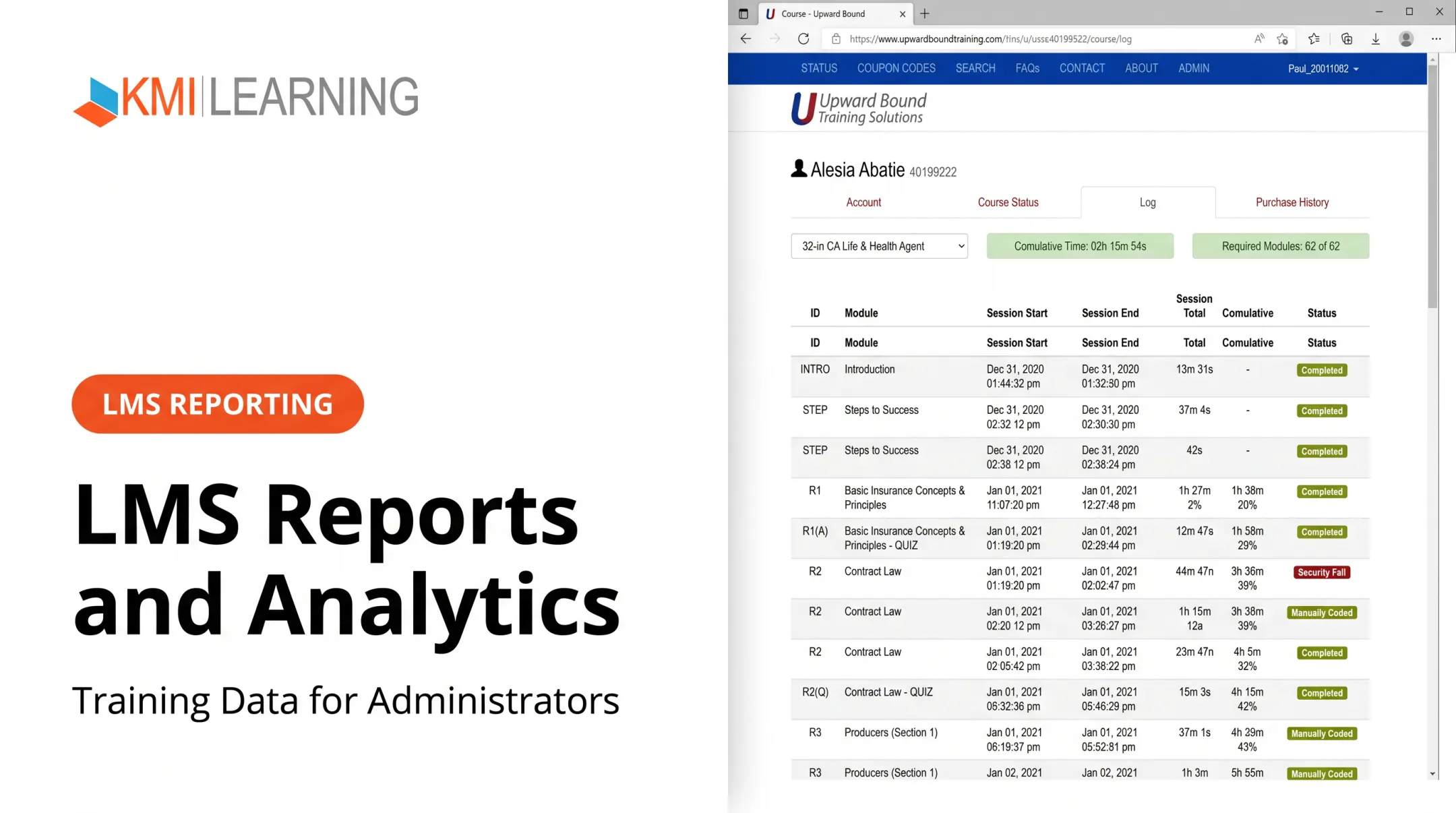
A configurable LMS centralizes enrollment, completion, assessment, certificate and continuing education records, learner activity, and custom reports. That makes it easier to connect training data with HR, quality, or operations data. Standards help too: SCORM maps completion and score, while xAPI records richer activity in a learning record store.
KMI Learning is one example of a configurable, white-label LMS partner. Its platform supports custom reporting, dashboards, exports, BI integrations, and CE credit tracking for organizations with complex training or compliance needs. Records retention matters here as well; IACET guidance calls for keeping training records available for at least seven years.
How to Turn Evaluation Findings Into Program Improvements
Evaluation pays off only when it changes something.
- Look for patterns. Compare learner groups, spot gaps, and pair dashboard figures with representative comments and documented limitations.
- Report by audience. Each report should state the key finding, evidence, interpretation, recommended action, owner, and review date.
- Refine and repeat. Adjust content, format, accessibility, reinforcement, manager involvement, technology, or measurement design, then evaluate again.
A federal case shows the loop. An IRS new-hire training model lacked a terminal objective. The redesign tied training to examination quality and used career learning plans to close gaps.
Trained cases later scored higher on quality standards. OPM still credited closer guidance from instructors and managers as a probable factor, so causation was not established.
Evaluation is ongoing. GAO's 2026 training guide treats it as continuous across planning, design, and implementation.
Frequently Asked Questions
What are some effective evaluation methods for staff development?
Surveys, assessments, interviews, observations, manager feedback, LMS records, work samples, and performance data all work. Using several together gives a fuller picture than any single method.
What are the 5 steps of staff development evaluation?
Align stakeholders, set questions and baselines, collect evidence, analyze and interpret findings, then report and act. The CDC's official framework has six steps; this is a condensed grouping.
What are the 7 types of evaluation used in staff development?
No single seven-type list is standard. The CDC names five: formative, process, outcome, impact, and economic. Other sources group types differently, such as formative, process, and summative.
How do you measure the ROI of a staff development program?
Isolate the program's effect, monetize credible benefits, and divide net benefits by fully loaded costs. Benefits you can't credibly convert to dollars should be reported separately as intangibles.
When should you evaluate a staff development program?
Before delivery to set baselines and objectives, during delivery for implementation feedback, and right after training for learning. Check later for behavior transfer and organizational outcomes.