Introduction
SCORM and xAPI both help organizations deliver, connect, and measure digital learning. They solve different technical problems, though, and picking the wrong one can mean rebuilt courses or reporting gaps later.
The choice matters whenever you're selecting an LMS, building compliance or continuing education courses, supporting mobile or offline learners, or planning integrations.
SCORM is still widely used: Learning Guild's 2025 survey found 81.7% of practitioner organizations reported using SCORM-based eLearning. The sample was 502 workplace L&D professionals, about 75% in North America, so treat it as a signal and not a US market-share figure.
This guide compares the standards side by side, explains when each fits, and covers cmi5 as a bridge.
Key Takeaways
- SCORM suits packaged LMS courses with completion, score, time, and pass/fail tracking.
- xAPI records experiences from apps, simulations, events, and workplace activity via an LRS.
- Neither wins outright; environment, data needs, and tooling decide.
- Many organizations run both, keeping SCORM and adding xAPI or cmi5 for new work.
SCORM vs xAPI: Quick Comparison
| Dimension | SCORM | xAPI |
|---|---|---|
| Delivery | Packaged course launched from an LMS | Statements sent from any compatible activity |
| Data | Defined runtime data model | Flexible actor-verb-object statements |
| Destination | LMS | LRS (standalone or inside an LMS) |
| Mobile/offline | Browser-bound | Possible with suitable design |
| Launch/packaging | Defined by the standard | Not defined |
Purpose and delivery model
SCORM courses are imported into an LMS as a package. A manifest file, imsmanifest.xml, describes the structure and resources. The LMS launches the content in a browser, and a JavaScript API handles runtime communication.
xAPI works differently. Any activity can generate a JSON statement ("actor, verb, object") and send it over HTTP to a Learning Record Store (LRS) or another compatible data store.
Tracking and reporting depth
The claim that "SCORM only tracks completion" is wrong. Its data model covers:
- Completion and pass/fail status (SCORM 2004 separates the two; 1.2 combines them)
- Raw, min, max, and (in 2004) scaled scores
- Session and total time
- Bookmarking and suspend data for resuming
- Question-level interactions and learner responses
xAPI goes further. Statements can carry results and context, and they can capture events outside any single course.
LMS dependence and data location
SCORM centers on the LMS: it launches the course and receives the data. With xAPI, an LMS can take part, but it doesn't have to. Per xAPI.com, the LRS can stand alone or live inside an LMS.
Mobile and offline learning
SCORM runs in a browser context and can't natively track native mobile apps. xAPI doesn't need a constant connection; occasional connectivity is enough to sync stored statements. That works only if the app, content, and LRS are built for it. Simulations and field-based learning are typical fits.

Packaging, compatibility, and effort
SCORM's package-and-upload workflow is familiar, and most authoring tools and LMSs support it. Confirm whether your platform supports SCORM 1.2, 2004, or both.
xAPI doesn't define packaging or launch. You'll need compatible tools, statement design, endpoint or LRS configuration, and reporting governance.
Best-fit use cases
- SCORM: LMS-hosted courses, compliance training, assessments, conventional completion and score reporting.
- xAPI: mobile learning, simulations, performance support, informal learning, cross-platform analytics.
What Are SCORM and xAPI?
What is SCORM?
SCORM stands for Sharable Content Object Reference Model. The Advanced Distributed Learning (ADL) Initiative created it in 2000 to make content interoperable, reusable, and durable. It sets rules for packaging, launching, exchanging runtime data, and recording progress.
Two versions matter:
- SCORM 1.2 (2001): simple and widely supported, with no sequencing.
- SCORM 2004 (editions 2004 to 2009): adds sequencing between SCOs and separates completion from success.
Verify version support in both your authoring tool and LMS before choosing.
Strengths: predictable delivery, familiar reporting, and broad compatibility.
Limits: LMS-based delivery only, plus a narrower tracking model.
Typical uses:
- Compliance courses
- Certification and continuing education modules
- Standardized assessments
- Existing course libraries where completion and score are the main requirements
What is xAPI?
xAPI, the Experience API (formerly Tin Can API), records learning as statements. Plain-language examples: "Maria completed the safety module," "Dev used the forklift simulation," "Ana attended the webinar." The current version is xAPI 2.0, published as an IEEE standard in 2023.
Benefits:
- Broader activity tracking
- Mobile and offline potential
- Cross-platform data
- Richer analytics
Requirements: an LRS or compatible endpoint, statement governance, integrations, and technical oversight. Inconsistent verbs like "complete," "conclude," and "accomplish" make records incoherent, so planning matters.
Typical uses:
- Mobile apps and simulations
- VR/AR experiences
- Webinars and conferences
- Workplace performance and social learning
xAPI won't improve instructional design, visuals, or engagement. It changes how experiences are recorded and analyzed.
Where cmi5 fits
cmi5 is an xAPI profile for LMS-launched courses. It adds packaging, launch, authentication, session management, and course-structure rules. cmi5-compliant content is also xAPI compliant.

xAPI vs SCORM: What Is Better?
There's no universal winner. Start by asking:
- What learning activities need tracking, and where do they happen?
- How much data do you need?
- Which systems must exchange information?
- What can your team support operationally?
When to choose each
- SCORM: packaged LMS courses, established authoring workflows, broad compatibility, and simple completion, score, time, or pass/fail reporting.
- xAPI: learning beyond the LMS, mobile or offline use, detailed interactions, multiple learning sources, workplace performance data.
- cmi5: new LMS-hosted courses needing xAPI data with defined launch and tracking behavior. Verify support across your authoring tool, LMS, and LRS; Rustici's cmi5 support list covers Rustici tools.
Count the full implementation cost
Compare total impact, not just the standard:
- Content redevelopment
- LRS and integration costs
- Technical skills and vendor support
- Data governance and reporting effort
- Security requirements and long-term maintenance
On security, the IEEE xAPI specification doesn't prescribe one authentication method. It leaves implementation to the provider and encourages HTTPS and industry best practices.
Buyer checklist
- SCORM 1.2 and 2004 support
- xAPI endpoint or LRS support
- cmi5 availability
- Offline behavior
- Data ownership and export options
- SSO and API integrations
- Accessibility and security controls
- Coexistence with existing content
A gradual migration path
- Keep SCORM courses that work.
- Use xAPI or cmi5 for suitable new initiatives.
- Pilot high-value content first.
- Decide which learner records must be preserved in any transition.

Rustici's SCORM-to-xAPI cookbook documents how SCORM events map to xAPI statements.
Real-World Examples and Case Studies
Visa University: xAPI for cross-system visibility
Visa faced siloed, compliance-oriented learning and wanted to connect learning activity to business priorities. It chose xAPI with an LRS to see how employees learned across sources, with progress data flowing to Watershed.
Watershed reports that more than 80% of the company interacted with the digital campus within six months of launch. That's vendor-reported engagement, not a measured learning gain, and no business-performance figure was published.
The trigger was reach: learning happened in many places, and a single LMS record couldn't see it.
Getinge: SCORM 2004 inside a multimodal program
Getinge, a global medical technology company, needed an extended-enterprise LMS for product-specific clinical training, auditable CE certificates, and surges during Respiratory Care Week.
Its KMI Learning program combined SCORM 2004 eLearning with Webex and AttendNow webinars, plus registrations, attendance tracking, and prerequisite logic. The platform supported more than 10,000 learners in short windows, with 1,000 to 2,000 daily logins and peak concurrency of 100 to 200 users.
The takeaway
Each case matched the standard to a clear driver:
- Getinge: Auditable certificates and surge reliability, which packaged SCORM courses handle well
- Visa: Visibility into learning across systems, which pointed to xAPI

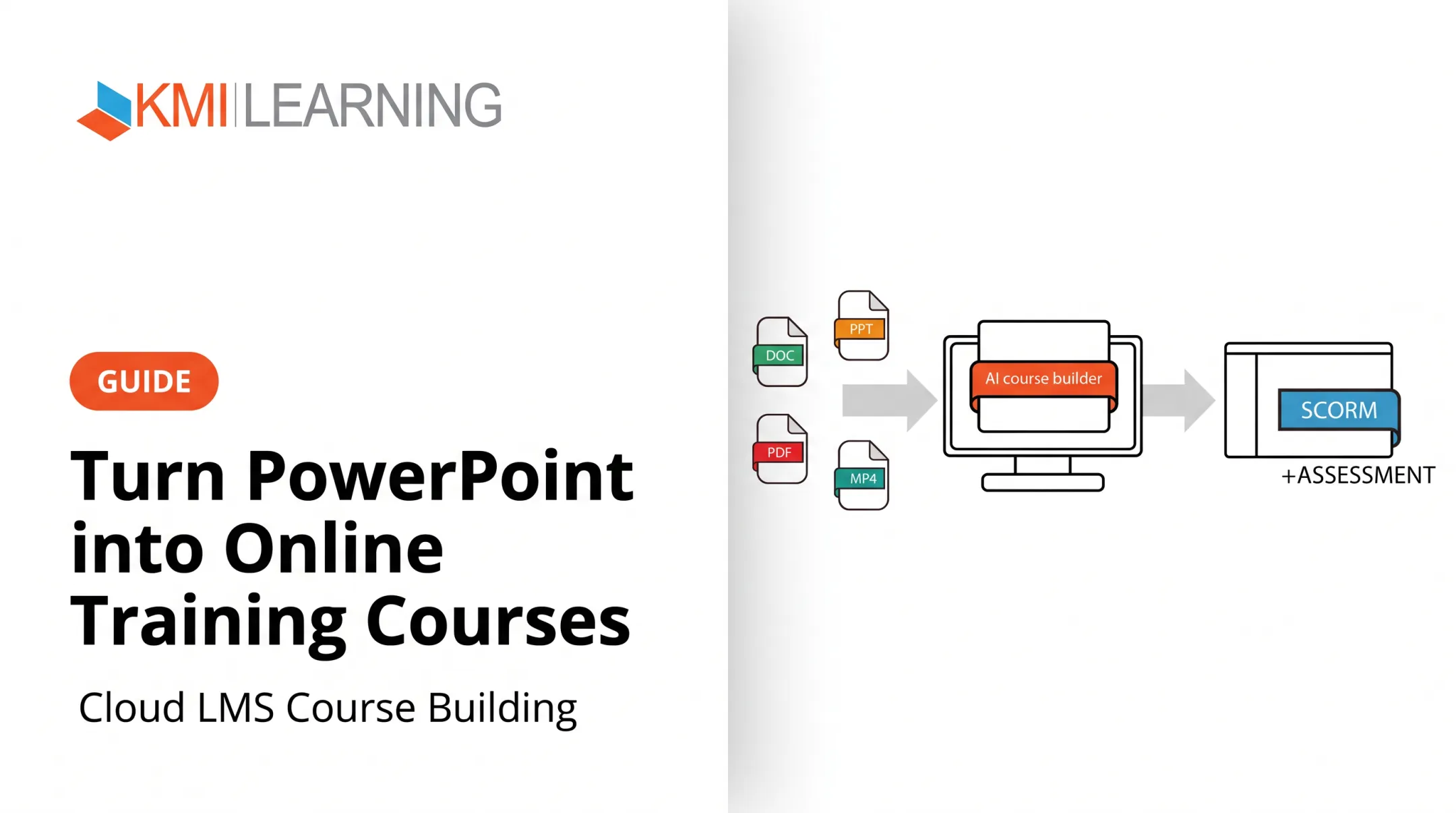
KMI Learning's LMS supports SCORM 1.2, SCORM 2004, and xAPI (Tin Can). Its AI Course Builder also converts PDFs, manuals, and slide decks into SCORM-compliant courses. If you're weighing standards, review your LMS and content requirements with KMI Learning.
Conclusion
SCORM stays practical for packaged, LMS-based learning with conventional reporting. xAPI fits when you need varied experiences and richer activity data. cmi5 can bring structure to xAPI-based courses.
Weigh these factors before you choose:
- Content type and delivery format
- Learner environment (LMS-only or multi-system)
- Reporting depth and analytics needs
- LMS and LRS capability
- Integrations, security, and migration effort
- Long-term vendor and standard support
Evaluate the whole learning ecosystem before committing to a standard.
Frequently Asked Questions
Is xAPI better than SCORM?
xAPI is more flexible for tracking experiences beyond an LMS. SCORM often fits better for packaged courses, broad compatibility, and straightforward completion reporting.
What is xAPI for LMS?
xAPI lets an LMS or connected ecosystem record activity statements, usually through an LRS. That includes learning that happens outside a traditional LMS course.
What does SCORM stand for?
Sharable Content Object Reference Model. It governs how eLearning content is packaged, launched, and tracked in an LMS.
Do you need an LRS to use xAPI?
xAPI statements must go to a learning record endpoint, commonly an LRS. An LMS isn't required, and the LRS can be built into one. Exact requirements depend on vendor architecture.
Can SCORM and xAPI be used together?
Yes. Keep SCORM for existing or conventional courses and use xAPI or cmi5 where you need broader tracking.
Is cmi5 the same as xAPI?
No. cmi5 uses xAPI but adds rules for packaging, launching, assigning, and tracking LMS courses. They're related, not identical.