That uncertainty causes real problems. Employers over-assign generic courses, miss state-specific deadlines, or can't prove completion when an auditor asks. This guide gives you a practical framework: identify what applies, separate legal mandates from recommendations, assign learning by role, and keep records that hold up.
Key Takeaways
- Map federal, state, local, industry, role, and contract obligations before assigning any course.
- Label each course as legally required, employer-required, or recommended.
- Schedule onboarding, recurring refreshers, and event-triggered training separately.
- Automate assignments, reminders, and records with an LMS, but keep legal review in place.
What Is Mandatory Compliance Training?
What it means
Mandatory compliance training is education employees must complete because of a law, regulation, contract, accreditation standard or employer policy. Three categories are worth keeping apart:
- Legally mandated: an OSHA standard or state harassment statute requires it.
- Employer-required: your policy demands it for operational reasons.
- Recommended: guidance suggests it to reduce risk, without a legal mandate.
The EEOC's 2016 harassment task force report, for example, recommends training as part of a holistic prevention effort. It is not a blanket federal training mandate.
Why it matters, and its limits
Good training supports safer conduct, ethical decisions, privacy protection and readiness for audits. But training alone doesn't create compliance. You also need clear policies, reporting channels, supervision, enforcement and documented corrective action.
Mandatory training versus onboarding
Onboarding (or new-hire orientation) is what someone completes when starting a job. It mixes general items, such as policies and systems access, with role-specific compliance assignments. Keep the two distinct: onboarding happens once, while compliance training often recurs or is triggered by events like a role change or new hazard.
Which Mandatory Compliance Training Requirements Apply in the U.S.?
Federal baseline
No single federal course covers every employer. OSHA says its Outreach program is voluntary and doesn't satisfy standard-specific training. Requirements attach to specific activities, roles, and regulated sectors:
- OSHA Hazard Communication: training at initial assignment and when a new chemical hazard appears.
- OSHA bloodborne pathogens: at assignment, at least annually, and when tasks change; records kept 3 years.
- HIPAA Privacy Rule: covered-entity workforce trained on PHI policies within a reasonable period; documentation retained 6 years.
- FINRA: registered persons have annual Regulatory Element and Firm Element duties.
- Federal ethics (5 CFR 2638): initial training within 3 months for new covered employees.

Staffing is a common blind spot. OSHA expects the host employer to provide site-specific and job-specific training for temporary workers, and joint responsibility for violations is possible.
State and local rules
Sexual harassment prevention training is one of the most common state mandates. Rules differ sharply on who must train, how often, and how long to keep records:
| Jurisdiction | Who | Renewal | Records |
|---|---|---|---|
| California | 5+ employees; 1 hour (staff), 2 hours (supervisors) | Every 2 years | 2 years |
| New York State | All employers | Annually | Encouraged |
| New York City | 15+ employees | Each calendar year | 3 years |
| Illinois | All employers | Annually, by December 31 | Required; period unstated |
| Connecticut | 3+ employees (supervisors if fewer) | Supplemental at least every 10 years | Unstated |
| Maine | 15+ employees | No interval stated | 3 years |
| Delaware | 50+ employees | Every 2 years | Unstated |

California also requires workplace violence prevention training (SB 553) initially and annually, with training records kept at least 1 year and incident logs 5 years. Verify each rule against the official agency source before relying on it.
Industry, role and contract requirements
Industry rules add layers: banks need BSA/AML training for appropriate personnel, and healthcare organizations face HIPAA Security awareness duties. Contracts matter too:
- FAR 52.203-13 requires an ethics program and periodic training where the clause applies.
- CMMC Level 2 covers security awareness and insider-threat training for covered defense contractors.
- NIH requires research-security training certification for applications due on or after May 25, 2026.
- Joint Commission standard HR.01.05.03 requires workplace violence training at hire and annually for accredited hospitals.
Supervisors often need more: California requires 2 hours versus 1, and Maine and Delaware add supervisory content.
Build a requirements matrix first
Before assigning a single course, build a matrix with these fields:
- Jurisdiction, department and job role
- Risk area and legal or policy source
- Required audience and due date
- Renewal trigger and assessment requirement
- Evidence to retain and content owner
Have legal, compliance, HR, security and operations review it before it becomes your official plan.
How to Build a Mandatory Compliance Training Program
Step 1: Inventory obligations and risks
Start with the sources that create real obligations:
- Laws and contracts
- Accreditation standards
- Internal policies
- Incident history and audit findings
Separate confirmed requirements from assumptions. Ask legal and compliance to confirm scope, covered workers, subjects, timing and evidence for each.
Step 2: Segment employees by role and exposure
Group learners by the factors that change risk and duty:
- Location and employment status
- Department and data access
- Supervisory authority
- Workplace hazards and public contact
Then build role-based learning paths. A warehouse picker shouldn't receive the same assignments as a payroll analyst.
Step 3: Define measurable objectives
Write objectives as observable actions:
- Recognize a reportable incident
- Protect sensitive data
- Escalate a concern
- Follow an emergency procedure
Match each objective to a scenario, knowledge check or practical demonstration.
Step 4: Select, create and validate content
Compare off-the-shelf, internal and custom content on legal accuracy, relevance, accessibility, update responsibility and integration needs. Generic courses can cover basics, but they can't teach your site-specific procedures.
Have experts and legal reviewers approve content. Record the version, approval date, sources and next review date.
Step 5: Set the training calendar
Run separate clocks:
- Onboarding: within the legal or policy deadline.
- Recurring refreshers: annual, biennial or as the rule specifies.
- Triggered training: role changes, transfers, policy updates, incidents, audit findings.
- Return from leave: set a clear rule.

Tie due dates to the real requirement, and define how managers handle overdue work and exemptions.
Step 6: Govern and update
Assign owners for:
- Monitoring regulatory change
- Reviewing content
- Approving revisions
- Retiring old versions
Use documented change control that states when retraining is required and preserves completion records for prior course versions.
How to Deliver and Administer Mandatory Training
Automate assignments and reminders
An LMS can handle the operational side of mandatory training:
- Assign courses by role, location, or employment event
- Send reminders and escalate overdue learners
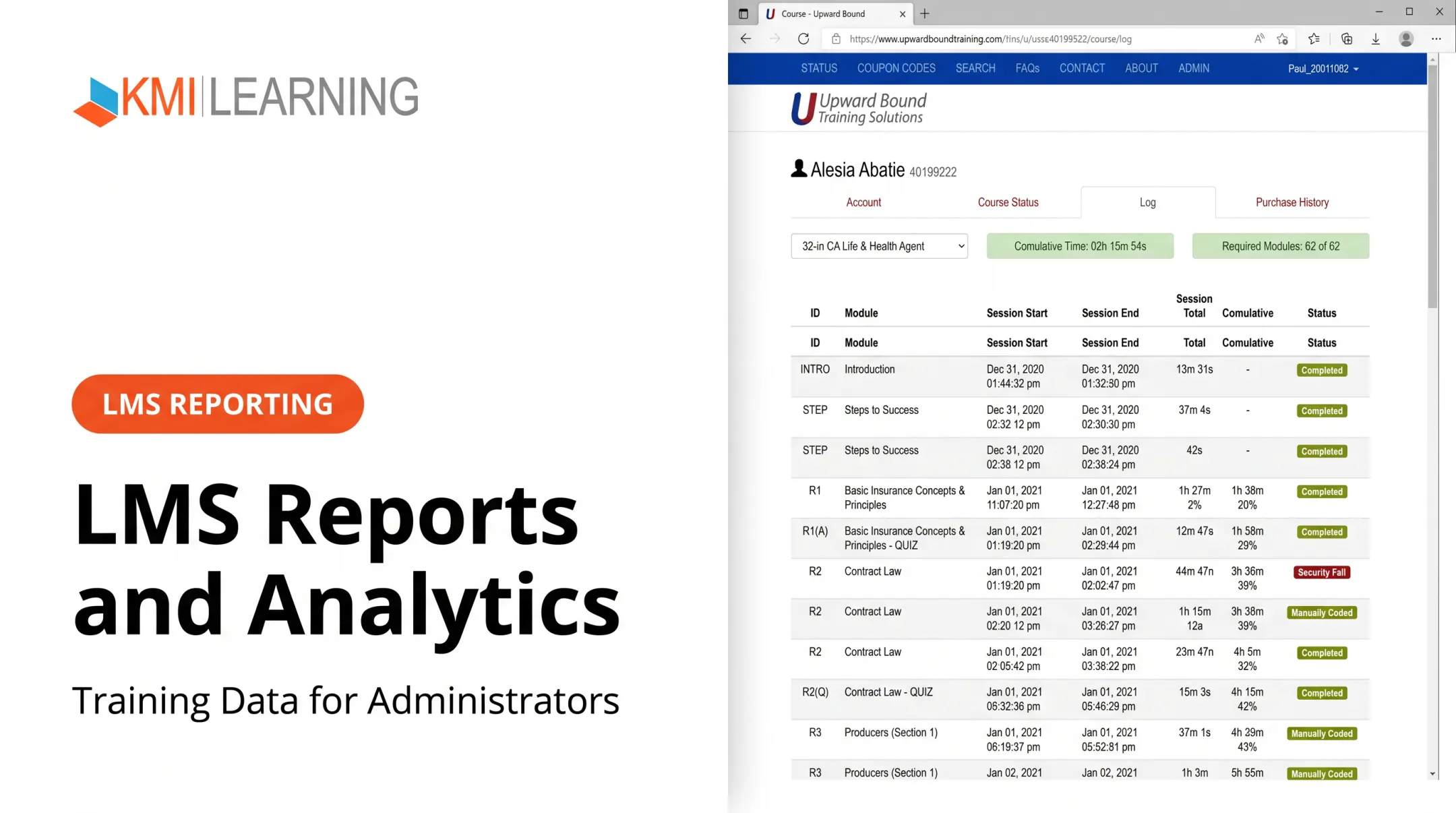
- Issue certificates and show completion dashboards
Renewal cycles vary. Some training renews annually, lift-truck certification every 3 years, and reminders can go out 30 days ahead.
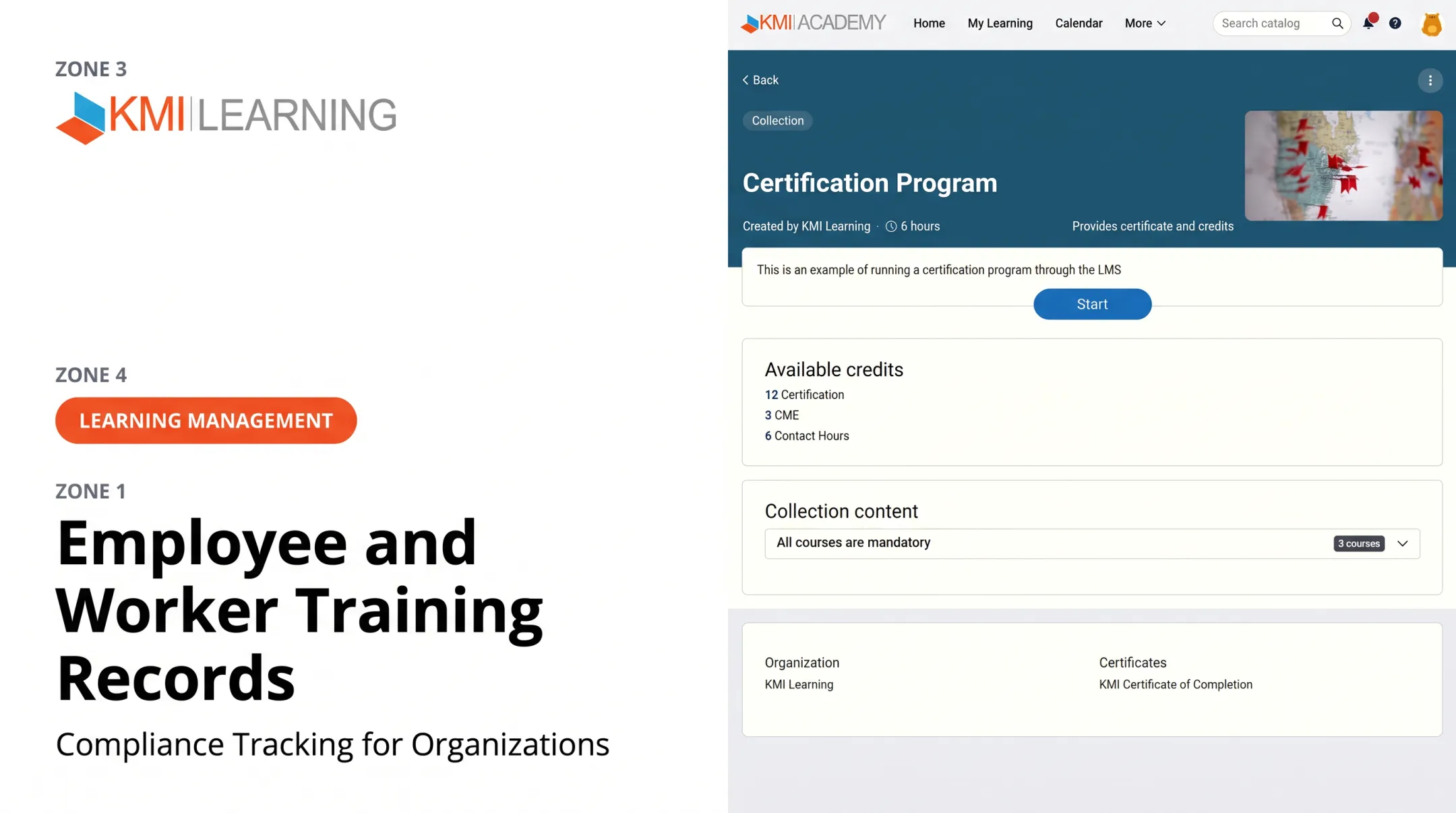
KMI Learning is one option for organizations with complex needs. Its configurable white-label LMS offers flexible integrations, audit trails, role-based access, custom reporting, and FedRAMP-compliant variants for government work. It supports HIPAA-friendly configurations and helps run your program without replacing legal review.
Design for completion and application
- Keep modules concise and mobile-friendly.
- Provide captions, transcripts and accessible design.
- Use realistic scenarios and knowledge checks.
- Give clear instructions for reporting concerns.
Accessibility has legal weight. ADA reasonable accommodation applies to employer-sponsored training, and covered federal ICT follows Section 508. Tailor examples to each learner's job while keeping required legal language intact.
Assign ownership
Spell out ownership for:
- Approving content
- Assigning training
- Following up with overdue learners
- Answering questions
- Reviewing results
Communicate why the training matters, what employees must do, where to get help, and what happens when training isn't completed.
How to Measure, Document and Improve Compliance Training
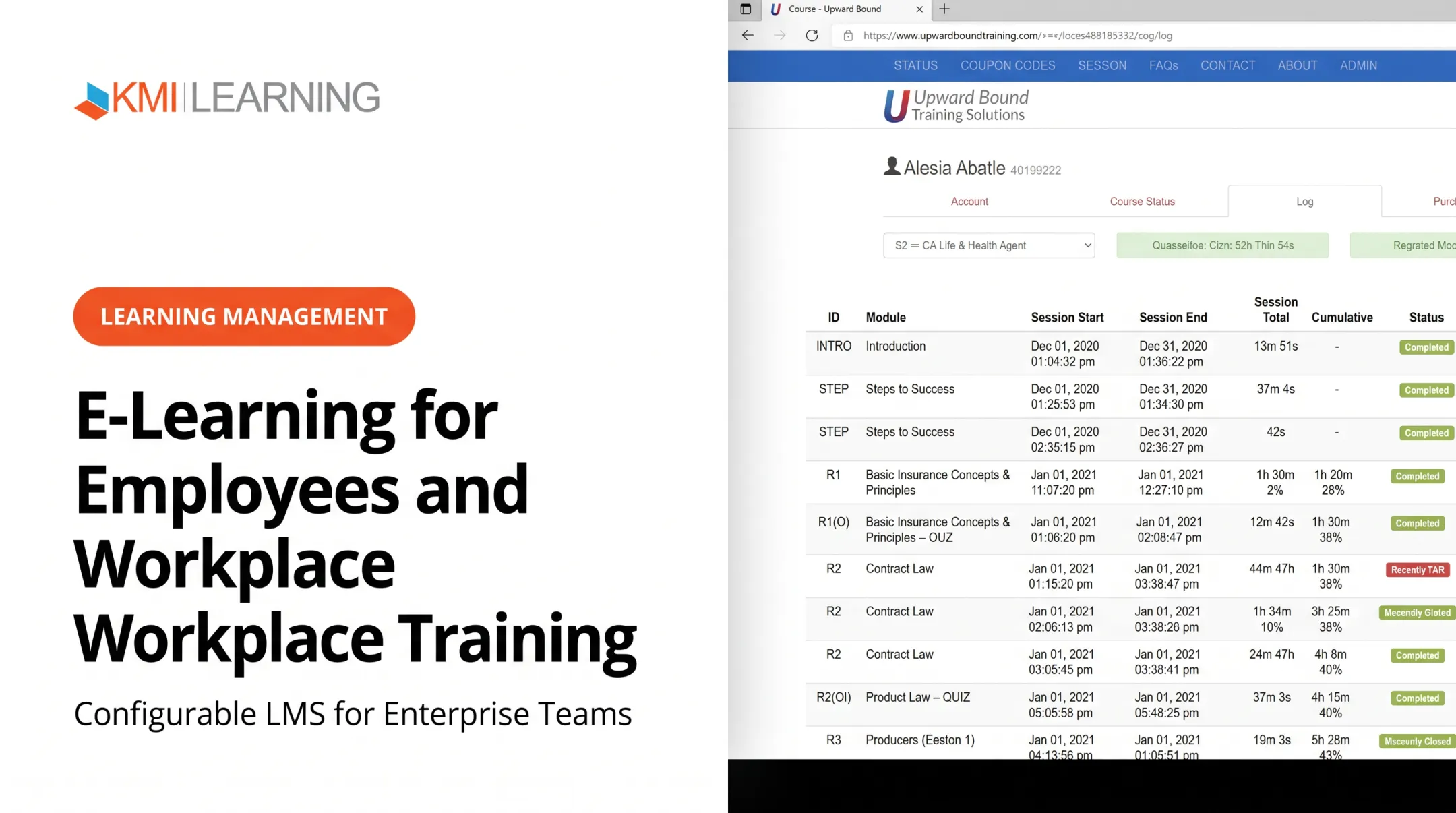
Maintain complete records
Keep records that include:
- Learner identity, course and version
- Assignment and completion dates
- Assessment results and certificates
- Exemptions or accommodations
- Reminder history and approver
Retention periods vary by authority. HIPAA documentation runs 6 years, bloodborne pathogens training records 3 years, and California harassment records 2 years. EEOC rules generally set 1 year for covered private-employer records. Use the longest period that applies to you, and confirm it with counsel.

Measure more than completion
High completion can coexist with poor understanding. The DOJ's compliance program evaluation asks about engagement, learning and effectiveness, not just attendance. Track:
- Assessment and knowledge-check results
- Learner feedback and repeat attempts
- Time to completion and overdue trends
- Manager follow-up
Use scenario-based checks to test whether people can apply the material. Failing quiz scores can also alert supervisors automatically.
Report by audience and risk
Build filtered views by department, role, location, manager, course, deadline and status, without exposing unnecessary personal data. Match each view to the audience:
- Executives: risk summaries
- Managers: overdue lists
- Auditors: evidence packages
- Administrators: operational detail
Connect training data to real signals
Compare training results with audit findings, policy questions, incidents, hotline activity and security events, without claiming direct causation. A 2022 NIST study of federal security-awareness programs found completion tracked by 84% of respondents, phishing click rates by 72% and audits by 67%. Those are rates of metric use, not proof that training works.

Enforcement shows why records matter. In September 2026, HHS OCR settled with Ambry Genetics for $700,000 after identifying risk analysis and access control failures. The corrective plan included workforce training on Security Rule policies.
Review and improve
Review the program periodically with learners, managers, experts, legal and administrators. Look for outdated content, confusing instructions, accessibility barriers and missing roles.
Then revise content, adjust assignments, update the matrix, and document the decision and its effective date.
Frequently Asked Questions
What are mandatory training requirements?
They depend on applicable federal, state, local, industry, role, contract and employer-policy obligations. Verify current rules with authoritative sources and qualified counsel.
What is the training called when you start a new job?
It's generally called onboarding or new-hire orientation. It may include mandatory compliance courses alongside policy, systems, safety and role-specific training.
Which mandatory compliance training does a U.S. employer need?
There's no single list. Requirements follow workforce location, industry, job hazards, data access, regulatory status, contracts and internal policies.
How often should employees complete mandatory compliance training?
Timing is set by a law, regulator, contract, certification, policy or risk event. Manage onboarding, recurring refreshers and update-triggered training separately.
How should employers document mandatory compliance training?
Keep assignment and completion records, course versions, assessment results, certificates, exemptions and reminders. Retain them for the period your applicable requirements and policies demand.