A white-label LMS lets you present employee, customer, partner, association, continuing education, or compliance training as your own. But a true white-label LMS goes past a logo swap. The domain, login, emails, certificates, workflows, and reports should all reflect your brand and how you operate.
This guide defines white labeling, lists selection criteria, compares five platforms for US organizations, and covers cost, security, and integrations.
Key Takeaways
- A white-label LMS is built by one vendor and rebranded so learners see your identity only.
- Test domains, vendor-mark removal, emails, certificates, roles, reporting, and integrations, not themes alone.
- KMI Learning fits associations, agencies, nonprofits, and corporate teams with conference, CE, or compliance needs.
- Compare total cost of ownership, not list prices alone.
Overview of White-Label LMS Platforms in the US Market
What Makes an LMS Truly White-Label
A standard LMS usually lets you change a logo, colors, or theme. A white-label LMS removes the vendor from view. TalentLMS's documentation, for example, breaks the experience into separate components.
- Custom domain replacing the vendor's portal address
- Branded login page and learner portal
- Emails sent from your own address
- Certificates with your templates and logo
- Hidden "Powered by" references
- Optional branded mobile app (often plan-dependent and extra cost)
Treat each as its own line item. Vendors rarely include all of them at every price tier.
Why US Organizations Buy One
Common use cases:
- Employee onboarding and mandatory compliance training
- Customer and partner education
- Association training and CE credit tracking
- Certification programs
- Multi-audience delivery from one system
Associations feel the pressure in particular. A 2025 Boundless survey reported by Associations Now found 48% of 208 decision-makers cite budget constraints as a barrier to better learning technology.
The platforms below are judged on branding depth, learning features, security, integrations, reporting, scalability, and implementation support.

Top White-Label Learning Management Systems for US Organizations in 2026
This is a practical comparison, not a universal winner's list. Weigh each platform against your audience, training complexity, branding needs, security obligations, budget, and technical resources.
1. KMI Learning
KMI Learning, based in Columbus, Ohio, was founded in 2000 and has more than 25 years of custom LMS development behind it. It serves associations, government agencies, nonprofits, healthcare organizations, and corporate teams across the United States.
Where it stands out:
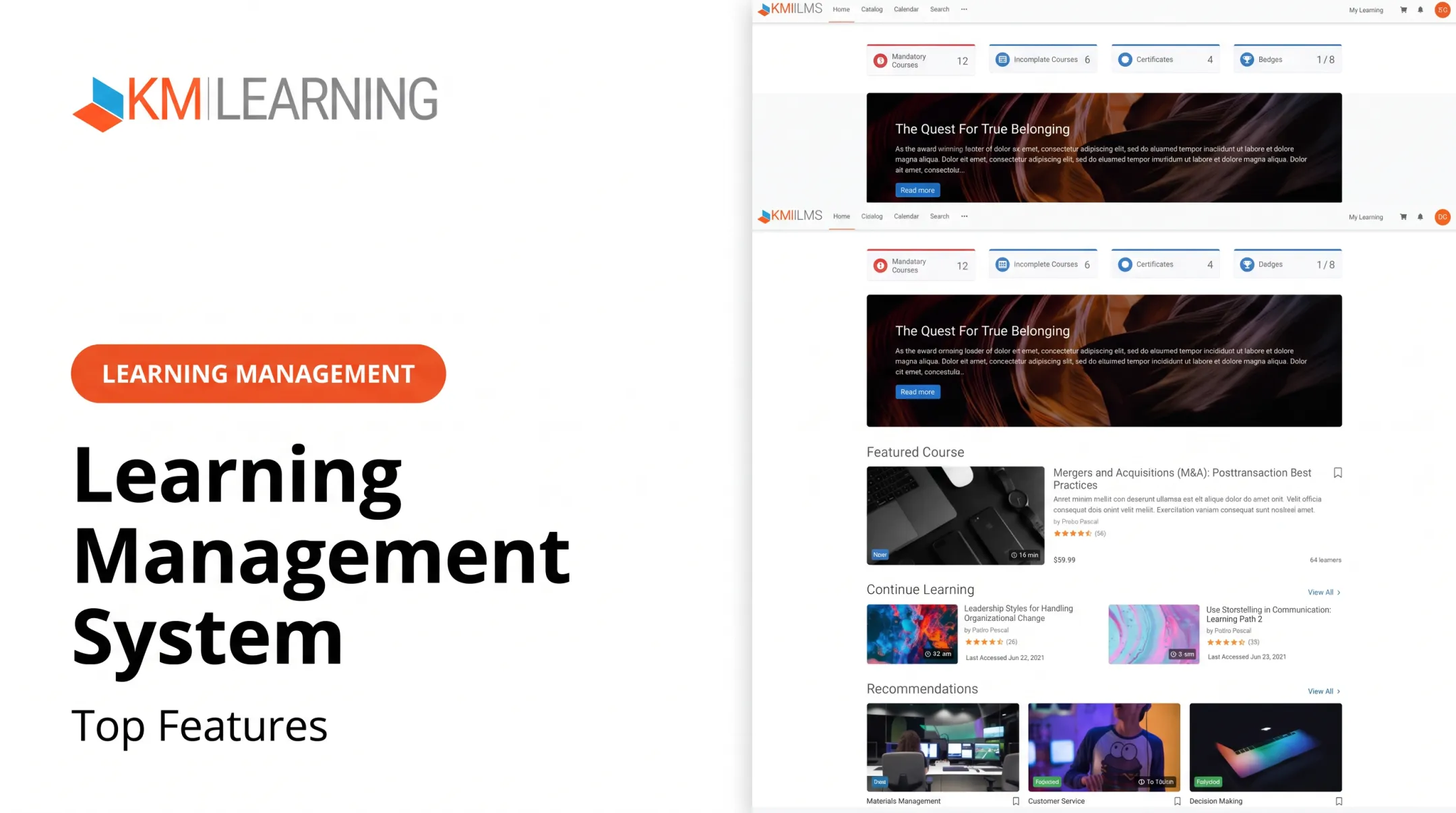
- Fully white-label portals: your logo, colors, domain, certificates, and emails, with no "powered by" branding
- Conference management and training delivery in one platform
- Automated CE credits and certificates
- REST APIs, SAML and OpenID Connect SSO, and custom reports
- Dedicated implementation managers who handle migration and custom development
- AI Course Builder, which converts documents into SCORM-compliant courses
KMI also offers FedRAMP- and TX-RAMP-compliant variants. Ask which variant applies to your deployment and request the current documentation, since government designations attach to specific offerings. Its clients include Accenture Academy and Medline University.
| KMI Learning | |
|---|---|
| Best for | Organizations combining branded delivery with conferences, CE, certification, compliance, or government security needs |
| White-label and workflows | Custom domains, branded emails and certificates, multiple portals, local administrator roles, approval workflows, custom reporting |
| Pricing and security | Active-user tiers with volume discounts, multi-tenant and flat-rate options; quote through proposal or demo. SOC 2 alignment, encryption, Section 508/WCAG 2.0 with VPAT available (WCAG 2.1 on the roadmap for Q1 2027) |
2. Docebo
Docebo is an enterprise platform for training employees, customers, partners, and multiple audiences. Its White Label app hides "Powered by Docebo," and Extended Enterprise supports separate portals with their own URLs, authentication, payment gateways, and branding.
Strengths:
- Headless delivery through APIs and webhooks
- eCommerce for courses and certifications
- AI features such as recommendations and auto-tagging
- A branded Go.Learn mobile app
Trade-offs: pricing is quote-based with no public dollar figure. A G2 reviewer criticized search and mobile usability. Expect more setup effort than simpler tools.
| Docebo | |
|---|---|
| Best for | Large organizations needing multi-audience learning and deep integrations |
| White-label and platform | Enterprise plan lists up to 10 domains and a branded mobile app; Elevate lists white-labeled design |
| Pricing and limits | Quote-based; Monthly, Yearly, or Registered Active User billing; may be heavy for small teams |
3. LearnUpon
LearnUpon suits organizations that want separate branded audiences without heavy administration. Portals hold separate users, content, and configuration, with custom URLs and LearnUpon references removed. Courses can be shared between portals.
Notes for buyers:
- Basic color, logo, and footer branding is available to all customers; the pricing page lists White Labelling under the Enterprise plan
- Integrations include HubSpot, Salesforce, Shopify, and an API
- The SCORM Exam/Interactions transcript report is not available for SCORM 2004
- A nonprofit reviewer on Capterra wanted finer control over administrator permissions
Those limits matter most when you weigh portal flexibility against plan tier and admin control.
| LearnUpon | |
|---|---|
| Best for | Teams wanting manageable, multi-audience portals and quick rollout |
| White-label and learning | Branded portals, custom URLs, eCommerce (plan-dependent) |
| Pricing and limits | Packages start at 100 (Employees), 150 (Associations), and 300 (Customer Education) users; no published rates |
4. Absorb LMS
Absorb fits established training operations with structured administration. It offers a custom-branded learner experience, role-based portals, and a customer-branded URL (with an SSL certificate requirement). Branding goes down to the department level.
Strengths:
- Automated certification and recertification, renewal workflows, and scheduled notifications
- In-app branding in its iOS and Android app
- Paid add-ons: Engage, Create, Analyze, and Amplify
Watch the reporting scope. Absorb Analyze is a paid enhancement for advanced reporting, and a G2 reviewer described difficulty with complex reports.
| Absorb LMS | |
|---|---|
| Best for | Mature training teams needing branded portals and compliance management |
| White-label and learning | Custom URL, department branding, certification workflows, mobile app branding |
| Pricing and limits | Quote-based, driven by learner count; add-on costs vary; confirm reporting needs |
5. iSpring Learn
iSpring (now marketed as iSpring LMS) pairs a straightforward LMS with course authoring. White-label options include your logo, colors, custom domain, vendor-mention removal, and a mobile app distributed under your brand. You can also run branded environments for customers, partners, franchisees, and members.
It is also the only platform here with public USD pricing:
| Business tier | Per user/month | Annual |
|---|---|---|
| 100 users | $6.91 | $8,286 |
| 300 users | $4.46 | $16,050 |
| 500 users | $3.97 | $23,790 |
Pricing counts active users, meaning anyone who logs in at least once that month. These figures don't include branded mobile app or multi-portal setup costs, so confirm both.
| iSpring Learn | |
|---|---|
| Best for | Teams wanting a simple branded LMS tied to course creation |
| White-label and learning | Logo, colors, domain, branded app, AI authoring tool included in core capabilities |
| Pricing and limits | Published tiers; enterprise and under-100-user pricing by request; portal limits not public |

How We Chose the Best White-Label Learning Management Systems
Each platform was scored on documented white-label features, customer feedback, and fit to a clear use case, not brand recognition alone.
Branding Depth
- Custom domains, login pages, dashboards, and catalogs
- Emails, notifications, and certificates
- Mobile branding and vendor-mark removal
- Separate branded portals per audience
Learning and Operations
- SCORM and xAPI support, per ADL's standards, plus assessments and learning paths
- CE and certification workflows, instructor-led training, eCommerce
- Roles, approvals, automation, custom reporting
- APIs, SSO (SAML 2.0, OpenID Connect), CRM and HRIS integrations
- Accessibility: WCAG and Section 508 for federal buyers
Risk and Total Cost
- Pricing model: per active user, per registered user, or flat license
- Learner and portal limits
- Implementation, migration, and integration effort, including real-world cost overruns
- Content ownership, support quality, and contract terms
- Security documentation such as SOC 2, ISO/IEC 27001, FedRAMP, or TX-RAMP
Verify government designations on the official FedRAMP Marketplace or the Texas DIR list. They apply to a specific cloud offering, not a whole company.

Conclusion
The best white-label LMS matches your audiences, branding depth, workflows, security requirements, integrations, budget, and support expectations. Feature count alone is a weak guide.
Request a focused demo or pilot with real courses, learner groups, certificates, reports, integrations, and approval workflows. Then compare implementation effort and total cost instead of relying on list prices.
Associations, government agencies, nonprofits, and corporate teams with complex conference, CE, compliance, or integrated training needs can talk to KMI Learning about a configurable white-label LMS and how implementation works.
Frequently Asked Questions
How much does a white label learning management system cost?
Cost varies with learner volume, portals, branding depth, integrations, security, implementation, support, and migration. iSpring publishes rates from $8,286 a year for 100 users; Docebo, LearnUpon, and Absorb quote through sales.
What is a white label learning management system?
It's an LMS built by one provider and rebranded by another organization, so your identity appears across the learner experience. A logo or color change alone isn't true white labeling.
What are white label platforms?
They're ready-made products that businesses brand, configure, and offer under their own identity while the original provider runs the technology. A white-label LMS is one example.
Is white labeling illegal?
No. It's generally lawful when licensing, reseller, trademark, content, and data-processing permissions are in place. Get legal advice for your specific arrangement.
What does LMS mean?
LMS stands for learning management system. It's software used to create, deliver, administer, track, and report on training or education.