
In all of employee training and especially in elearning the search for the elusive ROI (Return On Investment) is never ending. Actually the search is for proof. We all know in our guts that it works. We have plenty of anecdotes, lots of strong intuition and even the odd number now and then. But every once in a while some actual facts would be nice.

eLearning that Improves the Healthcare Industry
Recently Medline Industries realized the value add potential for more clearly defined ROI data for their product customers. As customers adopt Medline’s innovative product lines, they discover a drop in the number of UTIs, pressure ulcers, and other ailments commonly incurred while in a hospital. This is especially important because such ailments are no longer covered under government reimbursement programs. So hospitals stand to lose or save millions of dollars by reducing the number of such incidents. Fortunately, this is exactly what Medline’s products are designed to do. They provide easy to use, effective, and sterile tools for nurses and other caregivers which are specifically designed to reduce and prevent secondary infections or problems. In addition, Medline uses KMI’s custom LMS (Learning Management System) to develop and deliver comprehensive product training and CEU opportunities for nurses and other caregivers.This kind of outward facing elearning is commonly referred to as “extended enterprise”.
Calculating the ROI of eLearning
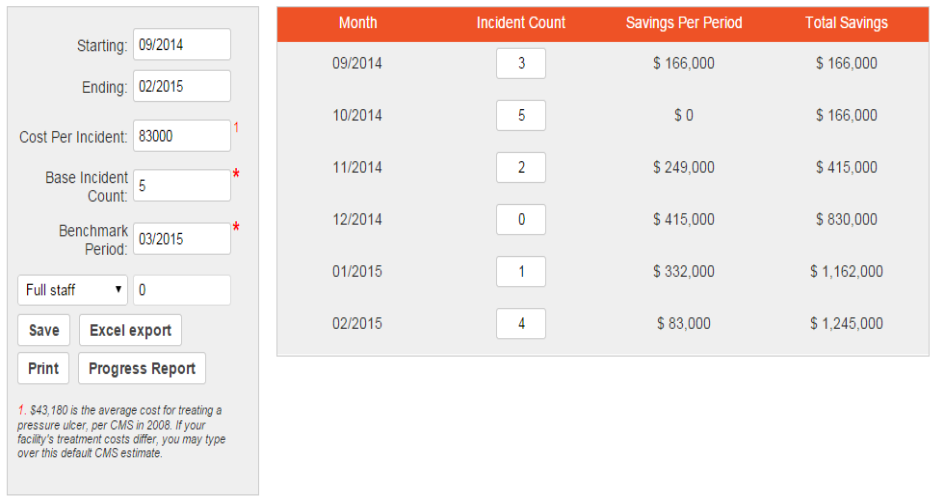 How then to show the money saved from using Medline products? Program calculators are the answer! Using legacy data to establish benchmarks and industry averages to better understand the cost of each specific hospital incurred ailment, Medline developed broad outlines for an ROI calculator. Using customized tools built within KMI’s custom LMS they were able to start tracking new infections/incidents on a per hospital basis. With KMI elearning technology powering the interface, Medline developed a sophisticated ROI graphing and calculator tool which demonstrates how the decrease of hospital incurred ailments relates to the number of Medline products and training courses used within the hospital. Because KMI’s LMS contains both the education records and hospital incident records, Medline is able to clearly demonstrate how, using their products and being well trained on their functions, can dramatically reduce hospitals’ out of pocket costs for secondary infections.
Expanding the eLearning ROI Calculator
The calculator functions have been customized for multiple similar scenarios, including vehicle accidents in a warehouse setting and process errors on an assembly line. In any instance where a mistake directly leads to out of pocket costs for the company, Medline’s program calculators can help. By correlating training time with number of errors, the ROI for using Medline’s products and training becomes clear. The more each employee is trained on how to use the product correctly, the less likely that employee is to make a mistake and custom elearning development provides that data.
We can’t reduce the cost of each mistake. But we can make those mistakes less frequent.






[…] Read the full story by KMI Learning Blog […]